Saturday, March 29, 2008
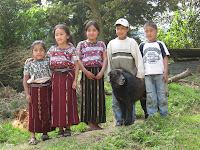
This is where I live
Saturday, March 22, 2008
Qingdao University Jiaozi

For the better part of an hour we made the kitchen hum banging against its surfaces with our chopping knives, eviscerating each ingredient one by one. Miggie kept a watchful eye on our progress. Nope, not quite there yet. Keep chopping. From the empty stairwell it sounded like Stomp had invaded our echoing apartment building.
When all of the ingredients were ready we squished together the pork, spicy ginger, green onions, soy sauce and egg. Then we squeezed dry handfuls of chopped cabbage and threw that in too. Working with especially fine, wheat flour, Amanda stretched out the dough in beautiful coils, and sliced it in half every now and then to examine its consistency; after conferring with the others, she would chop and reform the blob, until it felt and looked a lot like plasticine. Hunking off chunks the size of gumballs, Vivian and Amanda, kept the dough pinched between two fingers as they twirled and rolled each little mound into a thin palm-shaped coin. Then, handing them off to Miggie and me, we heaped the pork mixture into the middle, pinched the sides together, and scalloped the edges, setting it upright on the floured tray like a fan, or a swan. We fell into the rhythm of our work quickly, and must have made a hundred dumplings as we chatted and listened to music. From Miggie, Vivian and Amanda I learned that jiaozi is the most traditional northern Chinese food, and for all three, a favorite. They explained that it is a food that they closely associate with time spent with their families. During Spring Festival in February families get together and spend most of their time in the kitchen making and devouring jiaozi. Because their shape is similar to ancient Chinese money, they are thought to be very lucky and symbolize wealth. Some families hide a small silver coin in one of the dumplings during a jiaozi-making session. The lucky winner who eventually bites down on the coin, it is believed, will have a fortunate new year. This time we kept the RMB's out of the mix.
After the first batch was boiled, we invited Ethan down to go to town, and although we tried one or two while they were hot, we returned without a beat to the satisfying repetition of our work rolling out the dough and filling the soft bundles, one by one. When we had exhausted most of our ingredients we finally called it quits and sat down to feast, chopsticks poised, not caring that the table was still littered with the afternoon's mess. The girls whipped out the other dishes they had been hiding: spicy cabbage salad, egg drop soup, and a plate of quivering, brown poached duck eggs. Miggie held a sliver of duck egg to my mouth. "Eat it!" she commanded sweetly. "Really?" I meekly replied. "Yes, it's delicious. It smells bad, but it's delicious." Held under my nose, it smelled faintly like a mixture of vinegar and old cheesy socks; without thinking too much about it, I ate the duck egg for Miggie, my teacher, and it tasted a lot like it smelled. But the dumplings, bathed in a bit of vinegar, were perfect - the best I've ever had - and they did what I'm told they're supposed to do; they kept me warm all day.
Qingdao University JiaoziThe filling:
1/2 pound of ground pork
Two green onions chopped, and chopped some more
One Tablespoon of fresh, minced ginger
The better part of one head of cabbage, chopped and drained of all water
One egg
Soy sauce to taste
The dough:
Flour & Water
Dressing: Vinegar
Thursday, January 31, 2008
Diversified Attractive Activities Await Your Participation!

Adjusting to life here and settling into our new apartment - let alone getting to our new apartment - was full of, the mostly expected, ups and downs. When we arrived in Beijing we didn't have any concrete plans to get ourselves to our new home in Qingdao and we quickly learned that winging it in the winter in China was a whole lot different than winging it in sunny Guate. After we landed at the airport it took us a while to find a cab that would agree to take the two of us, along with our embarrassingly enormous pile of luggage (this was my fault), to the train station. And then the cabbie who was finally willing to do it must have only agreed because he was too tired to say no and approaching hour fourteen of his work shift. Every now and then on the highway as his eyes started to close, and his speed slowed, he would smack himself in the face and scrape his fingernails over his bald scalp to stay awake lifting his weary eyes to shoot me an impish look in the rear-view.
Once at the station we planned to get an overnight train to Qingdao so we lugged everything over the overpass and inside the enormous terminal where I hunkered down to wait on our enormous pile of stuff. Every now and then fellow travelers would gather around and scold me about all of my luggage. "That's too heavy for you!" At least I think that's what they were saying. And, yes, it was. Ethan took a couple of stabs waiting in the freezing cold lines for the ticket window but after a couple of hours we decided to call it a night and stay at a nearby hostel. We would get the first train to Qingdao in the morning where we would call our contact, Steven, at the University to come and get us. However, when we finally did arrive in Qingdao - we couldn't believe we had finally made it - and plopped ourselves in another busy terminal, we were unable to reach Steven after several tries and ended up deciding to take a taxi to the school. After a Mandarin mix-up between the words for East and South (if it wasn't for Ethan's Mandarin I'd still be wandering around Beijing's airport) we finally made it to the University, well the gate leading to the massive campus, and Ethan set out to look for Steven while I hopped around pathetically in the freezing cold waiting with our luggage. Finally, with the help of a saint-like Western Literature Professor, we were able to track down Steven's office and in moments were transported to our new apartment. Setting down our suitcases never felt so good.
We loved our apartment immediately. It's enormous with three bedrooms and a balcony, and fills up with beautiful morning and afternoon light. But settling in and making our new place live-able was harder than we thought it would be. First, it took a few days for the apartment to heat up; now thanks to an insulation project involving a bedspread, two sleeping bags, and some rope spearheaded by Ethan it's feeling much more comfortable. Then we discovered that our water heater was broken so if we wanted a shower we had to douse each other with water from the kettle heated up on the stove. Adding to the general discomfort we were required to undergo "physicals" in order to apply for our teaching permit which included a mysterious ultrasound, getting hooked up to an antique EKG, and a trip to the radiology department. And then, after our first delicious (now suspicious) seafood lunch with our co-workers, as I was just starting to feel a little more human and a little more comfortable, I got slammed with a stomach bacterial infection.
Anyway, now that I'm not vomiting and can take a hot shower I'm starting to feel human and hopeful about our time here. Yesterday, Ethan and I explored the old part of the city for the first time. We tromped around the fish market, got great views of the coast from a hill top park, and also visited several churches built during the German occupation as well as a Buddhist temple. After seeing the sights we had Mike, our hero/Western Literature Professor and his wife, Monica, over for dinner. We cooked a "western" meal of buttery lemon chicken, mashed potatoes and broccoli, and Mike and Monica brought homemade dumplings as well as a traditional soupy dessert made from fermented rice that was full of tasty sesame flavored gelatinous bubbles (which despite my description really was yummy).
It was fun to get to know Mike and Monica and hear what they had to say about China. They're both from Qingdao, love their country, and expressed an interesting mix of political opinions: censorship and control of the media = bad; cultural revolution = overly criticized. It was all really fascinating and surprising. I have to keep reminding myself that China is still very much a communist country - probably because I feel surprisingly surrounded by consumerism, and rows upon rows of stores and mega-stores with pretty things to buy.
Below are some pictures of old city in Qingdao. I wish I had pictures of the newer modern part of the city which is less Bavaria and more Las Vegas or Times Square. For a "small" Chinese city Qingdao feels immense and also surprisingly modern. (the buses here are fully equipped with flat screen TVs playing non-stop clips of Yao Ming!) After living in Guatemala it's hard for me to think of China as developing, but maybe our visit to the south will change this perspective. I can't wait to travel south and into Spring weather tomorrow!
Thursday, November 8, 2007
Los Muertos
Around mid-October my daily commute through the cemetery began to get a little complicated. At first I didn't realize what was going on, so I simply slowed my pace to avoid the ever increasing number of swinging paint cans, wheelbarrows, shovels and rakes slung over shoulders. Little by little the cemetery began to bloom. Tombs displayed shiny new veneers, beautiful flowers and wreaths. High above the blue sky flashed with soaring plastic homemade kites. Walking my bike past picnicking families perched atop their dearly departed, I eventually connected the dots. Xela's living was readying its dead for what is now my favorite holiday here in Guatemala, El Dia de Los Santos, or All Saints Day, celebrated on November 1st.
In a country scattered with clandestine burial grounds and whose death toll reached a horrific 200,000 during the 36-year civil war, I can only imagine that for most Guatemalans celebrating El Dia de Los Santos is more than a little bittersweet. Still, the mood in the cemeteries is friendly and even festive. Families honor their deceased loved ones by flooding their resting places with life. Prayers are sung, candles are lit, and enterprising animals feast on the treats laid out for the dead to enjoy: tamales, oranges, and opened cans of soda.
Ethan and I honored Guatemala's ghosts in our own sort of way. Two weeks before the holiday hit we visited the ancient Mayan ruins of Copan, Honduras, climbing its crumbling staircases and gazing up incredulously at the gigantic ceiba trees and intricately carved stelae. On our first day in Copan we entered the park after 3 PM which allowed us to return the next day for a repeat visit. We wandered through the park well into the early evening, and as most of the other visitors drained out and the witching hour began to glow, I sat quietly watching the valley fill with wildlife. Squawking macaws filled the trees and a handful of other brightly colored tropical birds chirped elaborately. Far below, overgrown rainforest rodents chittered and fought, racing over the ancient altars. Looking out across the Copan valley and watching the light hit the rock shaped thousands of years ago by Mayan hands, it wasn't a huge leap to imagine a time when the kingdom was full of market noise and ball court battles.
A week later, taking our first break from volunteering, Ethan and I signed up for a seven-day trek with Quetzaltrekkers, an organization that donates all of its profits to a school for street kids here in Xela called SEDELAC. The trek took place in the Ixil Triangle, a remote area in the Cuchumatane Mountains, home to some of Guatemala's most remarkable natural beauty as well as some of its most brutal massacres during the civil war. Ethan and I had been looking forward to the trek for weeks, not only because we were eager to hit the trail and leave the city, but also because the trek happened to end on El Dia De Los Santos in a town called Todos Santos, where we had heard the festivities were approached from a uniquely lunatic angle. Our guide book promised that the day-long drunken horse race was not to be missed. But even our most wild imaginings of riders wearing long red cloaks and beating their poor horses with live chickens (!) could not eclipse the six days of beautiful trekking in the Cuchumatane mountains, or the fun we had with our 16 other fellow trekkers from all over the world.
We met a lot of people along the way. Outside the cemetery in Nebaj we applauded as a graduate in cap and gown paraded past flanked by a sobbing mother and a beaming father, and a large extended family bringing up the rear. "Come to our house for tamales!" the father shouted.
Later, sitting inside the town's church Ethan and I accidentally crashed a wedding. No one seemed to mind so we stayed to watch as the bride walked down the aisle dressed in traje and a long white veil. On our way into the church I had noticed an older indigenous woman kneeling and crying in front of an altar just inside the church's entryway. We decided to leave before the "I do's" and so on the way out I stood where the woman had been kneeling. The altar was set back into the wall behind a large blue wooden cross. Behind the iron gate hundreds of small wooden crosses were fixed to the cement and scattered along the floor. Each bore a name and a date. A brightly colored painting hung above the gate depicting the plaza just outside the church's doors, but this scene was different: men, women and children were hog tied, blindfolded and bleeding. The altar was a memorial created to remember the innocent victims of the war. I scanned the crosses to find the most recent year: 1992 - just four years before the peace accords were signed.
Hiking through the foggy wilderness of the Cuchumatanes it was easy to see why the Guerilla Army used the Ixil Triangle as a base of operations; it must have been easy to remain hidden here indefinitely. Every now and then hiking past a fence or beneath a ridge I would look up in time to see a pair of quiet eyes fixed on mine. Sometimes the face would smile, but most often it would disappear quickly out of sight.
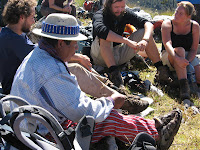
On our last day of trekking we summited La Torre, the highest non-volcanic point in Guatemala, with our host from the night before (pictured above in traditional Todos Santos traje). Sitting under the hot sun, surrounded by stunning views of the volcano chain, he told us his story, the story of his family and of his pueblo during the violence of the 1980s. Under the command of General Efrain Rios Montt, the fighting during the 1980s was particularly brutal and indigenous campesinos were regularly caught in the crossfire between left-wing rebel guerrilla groups and the Guatemalan army. Rios Montt is known for deliberately targeting thousands of indigenous Mayans who were suspected of harboring sympathies for the guerilla movement. Terrorized by regular acts of rape, torture and genocide, many indigenous populations, like the residents of La Ventosa, were persuaded to support the guerillas in exchange for protection from the Guatemalan army.
During one of the guerrilla army's regular visits to the town, many of the villagers of La Ventosa decided to add their names to the list of guerilla sympathizers. However, our host and his father remained ambivalent and ultimately decided not to join. After putting their names to paper, the residents followed the guerilla army's instructions agreeing to down power lines and destroy bridges in order to help disable the army's hold on the region.
Weeks later, our host was awakened before dawn to the sound of screaming. The army had some how gotten hold of the list of guerrilla supporters from La Ventosa and they were rounding up the entire village. Families and neighbors were forced to watch as one by one the guerrilla supporters were tortured and killed. One of the army's victim's that day was our host's uncle who was mistaken for someone else on the list by the same name. Because of an unfortunate scar his uncle had slicing his eyebrow, the army was convinced that he was not only a supporter but also a guerrilla commander. Despite the gruesome torture he was subjected to that day, his uncle miraculously survived, as did the man who shared his name. Our host expressed his grief and his anger at the guerrilla army for letting this happen to the people of La Ventosa. No one on the list had been protected. Later, stuck between the invisible protection promised by the guerrillas, and the terror committed by the army, many residents of La Ventosa agreed to join the army as civilian patrols. Once word spread to the guerrillas, they returned to La Ventosa to set and example. Like the army, they rounded up the civil patrolmen and lynched them in the town's center.
Hearing our host's story was of course heartbreakingly sad, but I was grateful for his candor and willingness to share it. I was grateful too for the way his teenage sons could sit on the mountaintop, aware of the tragic story their father was relating, but mostly enjoying the day and listening to their i-pods.
More than anything else, the festival was strange and sad. Like everyone else I went to watch the 12 hour horse race the next day and stood along the edge in the muck watching the men race back and forth, back and forth. As it turns out they thankfully don't use live chickens anymore to spur on their horses, but many of the riders were swilling beer, or riding hard and fast with their arms held out like airplane wings.
The crowd watched mostly in silence. There was no applause and no cheering. My nerves prickled with the knowledge that at any moment the worst might happen. And then it did. Around the middle of the day one drunken rider left from the wrong end of the track heading toward a line of charging horses at full speed. Two horses crashed with a god-awful sound and flopped upside down onto their backs. The riders lay still and the crowd surged around. Eventually the men stood up and the horses were led spastically out of the track. It's hard to imagine that the horses could have survived the collision. One indigenous woman turned to me and with rare emotion said, "They can kill themselves, but it's horrible - why do they have to kill the horses?"
The race continued for the rest of the day, and after the crash the spectacle seemed a little more subdued and the mood a little lighter. After experiencing the horror of the crash, what was left to fear?
Thursday, October 18, 2007
Half Time
The work week
Our volunteer schedule begins on Monday evenings when Ethan and I set out to meet with the other volunteers from El Nahual/Manos De Colores at a nearby cafe, The Blue Angel. Once gathered we gobble down their weirdly addicting vegan chocolate chip cookies, discuss the school's events for the week and share our lesson plan ideas. Every day El Nahual offers some kind of activity for the students and volunteers. My favorite: Wednesday night soccer! We rent out an indoor court and blow off our mid-week bike-transit steam by blasting soccer balls at each other - so fun! A close second would be the weekly community dinner (i.e. gorge fest) on Friday where students and volunteers get together in El Nahual's kitchen to attempt to outdo one another. Last week's feast included: Swedish meatballs, lasagna, and garlic bread made by me, Thai noodles with tofu, cinnamon buns and apple pie.
Although Manos De Colores runs an on-site afterschool program based at El Nahual, due to my schedule I'm currently teaching a total of eight English classes in three different off-site school programs: La Cuchilla (which refers to the shape of the neighborhood and means "razor"), Canton Candalaria, and Telesecondaria. Right now I'm happy with my schedule especially because it allows me to get to know three very different programs and three very distinct groups of students - however, after biking all over Xela, by the end of the week I'm wiped.
Some whining about getting there
In order to get to all of my school placements I first walk to El Nahual traveling past headstone shop row and a corridor of open doorways filled with women standing behind huge hot metal skillets, talking quietly and slapping out the tortillas that will be warm and ready to sell in the afternoon. If it's a nice day I cut up through the graveyard, the city's largest expanse of uninterrupted green, peppered with colorful cerulean tombs and wildflowers. As I get closer to El Nahual, the pavement gives way to rutted, eroded dirt roads. It's not uncommon to see a neighbor teasing milk from his goat, or the very same goat looking pleased and prancing (do goats prance?) having escaped from his tether. On this hill the children stop and shout: "Goodbye, teacher!" literally translating what is commonly used as a passing greeting here, Adios.
After the fifteen-twenty minute walk uphill to El Nahual, which never fails to wind me, I hop on my bike and head up to Canton Candalaria (in the morning) or La Cuchilla (in the afternoon). If I'm lucky I've managed to avoid the bike with the flat tire, or the one with the uncontrollable swiveling seat, or my favorite, the one with the brakes that drag against the tires on the uphill climb. The AM ride to Canton Candalaria takes us past the city dump on a steep, wet pocked road and brings us up near the base of the volcano, Santa Maria, on a path flanked by corn and small one-room houses. La Cuchilla provides a slightly more urban experience. We ride up towards the city's zoo and turn to go uphill past one of Xela's recent luxury developments, and then continue on up until we've reached the edge of the "razor." Each thirty minute ride leaves us sweaty with black boogers - thanks to the ever present car fumes.
On Wednesday's I walk five minutes from El Nahual to Telesecondaria. Oh, how I love Wednesdays!
La Cuchilla
For the past couple of months, every Tuesday and Thursday from 3 PM - 5 PM, we have offered afterschool programming for the kids in the community of La Cuchilla at the school, Escuela de La Republica de Holanda (the school receives a good amount of financial support from Holland). We divide the students into two groups, Kindergarten through second grade in one, third through sixth grade in the other. Each group receives an hour of English and an hour of Art. Starting last week, however, many schools let out for their three-month vacation which means that we now have many more students interested in attending the program. As "coordinator" I work closely with Betty, the director of the school and her husband, Jaime who happens to be the director of El Nahual. Last week I visited the school during the day to hand out announcements about the vacation program and give a little spiel in Spanish. This past week our numbers have swelled - we now have 70 students (in two very small classrooms) currently enrolled in the program. And, I expect even more to enroll today. Next week we will begin to offer programs at La Cuchilla in the morning from 9 AM - 12 PM (trading time slots with Candalaria), and after hiring a Guatemalteco teacher, we will offer Spanish Language instruction and Math in addition to the gringo-led English and Art.
Vacation program registration began last week. Students wanting to participate in the program were required to come to class with a parent and what Jaime refers to as a symbolic 10Q ($1.50), which is intended to give students and parents ownership of the program. It was great to finally meet many of my students' parents, and learn a little more about La Cuchilla through the adult community members, i.e. the mothers - no fathers were present, which is something they all joked about. At La Cuchilla the children are sweet, smart, fun and relatively well-dressed with sturdy shoes and backpacks. Because none of the children dress in traje, or traditional indigenous garments, I assumed that they were by and large ladino - a mix of Spanish and indigenous descent. However, after meeting their mothers, many of whom were dressed in traje, I realized that that was not necessarily the case. It's difficult to reconcile my students' joy and enthusiasm for learning with their apparently difficult lives and the realities of learning in a school with little resources. Speaking with Betty I learned that most of my students live crammed in a one-room house with a large extended family. Many of my older students are depended upon to care for their younger siblings while their parents work long, extended hours. Lunch includes a stop at the tienda across from the school which is stocked with candy and salty snacks. The school itself is friendly but barren, lacking classroom art or decoration, and basic supplies like books and playground toys. However, when teaching a song or playing a game with the students at La Cuchilla it's easy to forget the details. Even when sweeping out the rainwater that has gathered in the classroom overnight I have to stop and pay attention: my students’ lives are hard, yet here we are laughing, shooing out the several inches of water that has collected under their desks. Speaking with the students' mothers during registration I could feel the impact of our program in the community, and the hope and the excitement the opportunity to learn generates. Many of the mothers of my brightest students couldn't sign their name, nor provide me with a numbered street address.
Our latest project in English class at La Cuchilla is writing mini-biographies including photos to post on the classroom walls. I'm also really interested in starting a pen-pal project with a school in the states, hopefully Lansdowne Friends School, where I went to school and where my mother works. Tuesday we came up with classroom rules (all 70 of us); the vacation program is giving us a wonderful, fresh start.
Canton Candalaria
Canton Candalaria is an indigenous community just outside the city with stunning views of Volcano, Santa Maria. Unlike La Cuchilla, Canton Candalaria's poverty is overt and in your face. The children wear the same clothing to school every day (most of them wear traje) their shoes are riddled and worn, and without running water, hygiene and health are huge issues.
I teach two English classes here, one in the second/third grade class, and one in the sixth grade class. The ages range wildly in both classes. In the first class the students are anywhere from eight to eleven. In the second class most are fifteen and sixteen and will be faced with the difficult decision next year to work or continue their studies.
Teaching at Canton Candalaria is hard to say the least. With the help of volunteers from El Nahual, the community is hard at work on a new school building that can house all of the students. For now, the students learn crammed in small classrooms separated by plastic tarps or in families' houses. Hearing, seeing and participating in class is a huge challenge. And, it is virtually impossible to respond to individual students' needs. With the younger class I've been focusing on the alphabet, singing, playing bingo and doling out precious stickers as prizes. In the older class one of my favorite projects was in art class. I gave them a blank comic template, a couple of Calvin and Hobbes comic strips in Spanish as examples, and they created their own beautiful comic book characters and stories. We've compiled them all in a book titled by the students, "Las Estrellas" ("The Stars"). However, my favorite time with the students is during the break between classes. We sit out in the sun opposite the clanging construction of the new school building and play. We teach the students playground games like ring around the rosy, and songs like Bingo. They put their arms up for hugs and plead, "subeme!" ("lift me up!"). Ethan attracts the biggest line.
Like La Cuchilla, we'll be starting vacation programs soon. I'm hoping that the older group will continue to come. I'd like to start a community photography project with them where they can take pictures and describe their community in English.
Finally, Telesecondaria
Telesecondaria is a five minute walk from El Nahual. Every Wednesday I teach two English classes to students ranging in ages 13-17. As a teacher the classes at Telesecondaria are a lot of fun and in many ways easier to control because we teach during regular school hours. I've taught a lot of Side By Side curriculum in these classes as well as incorporated a lot of games. Unlike the teenagers at Canton Candalaria, who needed a huge amount of prompting and explanation to pass a ball around the circle for a name game, the students at Telesecondaria will gladly don a blindfold and spin in circles (this did have a connection to English class, I swear).
My second class at Telesecondaria takes place in Don Angel's classroom. Don Angel teaches Spanish every now and then at El Nahual and works with Jaime to coordinate the English program at the high school. Before teaching at Telesecondaria, I had heard a little about the program. Basically, Telesecondaria uses televisions in the classroom to cut educational costs. From 1 PM - 6 PM the students attend school and learn through educational videos and programming primarily. Not sure what to think about the program, I asked Don Angel to tell me more. In describing the school to me, Don Angel cited progressive Brazilian educator, Paulo Friere, saying that Telesecondaria is one of many similar school models used in developing countries to help make secondary school possible for more students. Does it work? Don Angel firmly believes that it not only works, but also encourages students to be critical thinkers. How it does this, or whether or not I agree with Don Angel is TBD. I'm also a little confused about the role of the teacher, who Don Angel referred to as a "mediator." I know the teachers participate in teacher training and now, because the school is a polling place for the segunda vuelta in November and has removed all of its primary teaching tools - the TVs, the teachers are the only teaching mediums. How the classes differ when the TVs are present and functioning in the classroom is unclear to me.
For the next couple of classes at Telesecondaria we will be coming up with presentations for their end of the year performance. My students will be using hip-hop in one class, and animals in the other to talk about what they've learned in English.
Monday, October 15, 2007
Ojalá
Not pictured: Benta and Mark, and Ethan (who was back in the states for a wedding)
Tuesday, October 2, 2007
Just Fever
On Sunday, Ethan and I went on a hike with our housemates, Emily and Kunal, to one of the most sacred lakes in Guatemala - Laguna Chicabal. Laguna Chicabal is a crater lake nestled at the top of an old volcano (I'm not sure if it's technically active or not). In order to avoid the niebla (fog - one of my favorite words in Spanish), we left at around 6 AM to arrive at the top of the volcano at around 9 AM, panting from the altitude and the steep climb. Our timing was perfect. From one side we got some great views of Santa Maria - the perfect cone-shaped volcano that you can see from just about anywhere in Xela, and its still active little sister, Santiaguito that erupted in the early 1900s burying the surrounding towns in several feet of pumice and ash. Looking over the other side, we could see straight down to chicabal, blue and shimmering.
In order to reach the lake we had to climb down some 600 steps, through a corridor of lush green foliage and mossy trees. Once at the base, we followed a trail around the water's edge taking us past Mayan altars, big blue crosses laden with flowers, corrugated metal and what looked like fireworks remains. We did our best to catch a glimpse of the misanthropic quetzal - to no avail - but we did see humming birds and heard plenty of el canto de los aves. As predicted, after lunch on the shore, the fog started to pour in over the lip of the crater swirling over the water and passing in between the trees. It's incredible how quickly the weather changes here. On the hike back we could see our breath, but little else - everything was softened and obscured by a heavy curtain of fog.
Our next stop at Hiper Paiz, the city's mall/walmart was not so sacred. After the hike Emily, Kunal and I stopped in to get some essentials (yogurt, jam) and while in line I smashed both accidentally (?) in the eerily bright white aisle (Kunal caught all the awkwardness on film). The check out lady was very nice and let me go replace them, but I'm not going back to "Hiper" (ee-pur) any time soon. I'd much rather do all my purchasing from the ladies in the outdoor markets who lower their jacked up extranjera prices once when you ask, "y por lo menos?" and then again in response to "con discuenta?" Anyway, since our hike, or as a result of the Hiper mishap, I've been laid up with the flu and a fever. I'm feeling a little better today and am hoping that I'll be able to get to La Cuchilla at 2 PM for El Dia Del Niño. October 1st is Guatemala's Dia Del Niño (Day of the Child) so throughout the week El Nahual has planned some special events for our ninos. Today's fiesta will take place at the Zoo for both students from La Cuchilla and Manos De Colores - we managed to get a piñata, a cake and collected and wrapped over 300 gifts for all of our niños - I don't want to miss it. Time for more tea.