Friday, May 30, 2008

Let Me OK!™

This week after watching and discussing some TV commercial parodies I found online (my favorite: a comedy sketch that I found on YouTube from Left of Center for "Invisi-bandages"), I gave my first year classes the assignment of writing and acting in their own TV commercials for products like toothpaste, shampoo and deodorant. Along with providing an excellent excuse to capture my students on film, it turned out to be a worthwhile, although definitely challenging group assignment. The students needed a lot of input and help, but after two class periods many of them ended up with some very creative products and incredibly funny commercials.

Some of my favorite products included:

Olympic Sneakers - "One world. One shoe."

Sunshine Toothpaste - (A toothpaste that turns your teeth different colors) "Light up your life. Light up your teeth."

Magical Laundry Detergent - A detergent that can change your life. Literally. It could change you into a polar bear.

And:

Dark Child Sneakers - "Street ball is my job"

Amazing.

But my favorite came from the superstar trio: Victor, Olivia and Amy - who, whenever I headed their way to check in on their progress demurred, refusing to give me any details - it was going to be a surprise. During their secretive rehearsals they could barely hold it together. I couldn't help sneaking peeks as they pumped their fists, chanting quietly in unison "Let Me OK!" - before dissolving into hysterics.

I've uploaded their commercial for Let Me OK™ Deodorant below. Victor plays the stinky fly ("I feel lonely and ashamed"). Olivia plays God (who kills and eats poor Victor the fly - which was actually a delicious, seasonal cherry - we are gorging ourselves these days). And Amy sells it while struggling to keep a straight face. Olivia introduces the product at the beginning of the clip, and Victor's buzzing signals the commercial's start. I hope you find this as hilarious as I do, but chances are that this is only something that a teacher, or that teacher's mother could really love.


P.S. Victor is the aspiring rock star in Ethan's post about teaching.

Tuesday, May 20, 2008

Where has the time gone?: Pictures from a bad blogger

Here are some things I've been doing recently...

Thursday, April 3, 2008

Controversial Topics

This morning after an unusually heated class debate on the topic of gay marriage, I ran into one of my students, Mars, at the bus stop. Contrary to his namesake, Mars perpetually sits in the back row beaming benevolently upon the rest of the class and occasionally making wisecracks. He is one of my most outlandish students, and easily one of my favorites. This morning the God of War and I sat together on the bus chatting about class and the usual topics: the weather, pollution, and inevitably, the Olympics -- Qingdao will host the Olympic sailing events this summer. "You know the smokestacks downtown?" Mars asked me chuckling. I nodded a little guiltily. Ethan got a great picture of one towering above a sign that reads: “Clean Energy Supply for Better Environment.” "Well, the government is destroying them now." He was still laughing. "Why?" I asked, smiling too, wondering what the joke might be. "Well, they don't want the foreigners to think bad about China so they are taking them all down, but...they even take down the ones that are giving off steam, not just smoke, because they worry about what the foreigners will say." We both laughed at this, the government taking down supposedly innocuous "steam-stacks" simply because they are worried about the impression it will give foreigners. But at the same time I had to wonder: who was I laughing at exactly? The government's less than thoughtful efforts to gain favor with foreigners, or the extreme environmental demands imposed on China by westerners? Where did Mars get this story in the first place? And how benign could these smokestacks, er, steamstacks really be?

Mars sighed and then looked at me intently, "But you know," he began seriously. "The real threat to China right now isn't pollution, it's the bad gangs." I paused to think. "Bad gangs? Like bang-bang?" I asked pointing my finger at him and firing. "No, no," he answered. "Bad gays." Oh, no not this again! I didn't think I could summon the energy to patiently address this issue for the second time that morning. "Bad gays...?" I asked forlornly. "No! Bad guys!" Ohhhh. Bad guys. "What bad guys?" I asked, relieved. “You know, the ones who want to divide China.” I knew at that point that we were talking about Tibet. Since the March 14th riots and the flurry of Chinese newspapers that had begun appearing in class, I hadn't broached the topic with any of my students, colleagues, or even our Chinese friends. I had read and heard enough to know that the accounts that the Chinese were following in the news were wildly different from the stories I was poring over in the New York Times through a serendipitous crack in the great firewall of China (many of our ex-pat friends can't access the site), and if I did mention Tibet and talk about my views I wasn't sure what the consequences might be. Sitting on the bus outside the classroom, I felt safe enough to at least utter the T-word, so I asked, "You mean in Tibet?" Mars nodded. After that, I didn't add much to the conversation. What could I say? Debates about gay marriage aside, the last thing I want is for a student to go to the administration with a list of grievances claiming that I'm a threat to Chinese security; I could be fired or sent home. I listened to what Mars had to say and recognized the familiar rhetoric plastered all over the China Daily, China's English newspaper. Mars, like China's journalists, was distressed that these "bad guys" were trying to divide the Chinese people.

If I were Mars, and all I had to read were Chinese publications like the China Daily, I'd probably be worried about the "bad guys" too. The headlines read more like "slam book" entries (think Babysitter's Club) or messages scrawled on bathroom stalls than actual news coverage, and the vast majority of the stories focus on vilifying the Dalai Lama and his "clique", critiquing the western media's supposedly "biased" coverage (one article dripping with irony angrily thanks the Western Media for "teaching" China about freedom of the press - click here to read.), and emphasizing the victimization of the Han Chinese without asking the question at the center of the violence - why is this happening? I've begun to collect headlines as souvenirs. Here are just a few from the China Daily web site:


Voices Rise to Counter biased Western Media

Evidence of Dalai clique's role in riots released


Don't see Tibet through tainted glasses


Do you call this peaceful?


Facts exposing Dalai clique's masterminding of Lhasa violence


Dalai clique racks brains to sabotage ethnic unity: living Buddha


China urges int'l to see true features of Dalai clique


Dalai Lama's 'Non-Violence' Stance Disproved by Lhasa Riot


The epicenter of lies


I wasn’t exactly surprised by the China Daily’s skewed news reporting. Early in our stay Ethan and I spent six hours riding around in a cab as a favor to a student who asked us to help her young journalist friend with an investigative report on whether or not taxi drivers could understand and respond to English-speaking tourists. The poor cab drivers had all learned the same unfortunate phrase -- “welcome to my taxi driver” -- but other than that only hand miming and the generous guidance in Mandarin from the back seat got us around town that day (Ethan wasn’t allowed to use his Chinese – one of the rules of the game). When we got a hold of a copy of the Qingdao Morning News the next day, we had a Chinese friend translate it for us and learned that 1) it was apparently us who had called the paper asking them to report on the topic, and 2) the cab drivers had passed their impromptu exam with flying colors. Not only that, we discovered we had missed out on the generous compensation that people usually receive for providing information to newspapers.


Just a few hours after talking to Mars I read an article in the NYT that traces China's reaction to the riots to a sense of injured nationalism (click here to read the article). China's nationalism, a nationalism I am struggling to understand, seemed to be just the issue in my conversation with Mars. Mars was saddened and concerned that "separatist" groups would want to hurt China in this way. He couldn't understand it. After reading the article I immediately clicked on the icon to share the link on my Facebook page - I hadn't realized you could do that before. When Ethan got home I found out he had read the article too, and was planning to send the link back home. When I mentioned that I had already linked to the page on my Facebook account with a description of the conversation I’d had with Mars, he did a double take. “You did what?” We spent the next fifteen minutes frantically deleting it before some phantom censor could read my comments, all the while joking about losing our jobs. The thing is we feel safe here, but we just don't know. We don't know what our colleagues think and we don't know what the consequences would be of sharing our views. Maybe our colleagues don't know either. So, between secret visits to the NYT website, Ethan and I talk about Tibet at home in our university apartment, trying to ignore the stories we heard from ex-pat friends recently over brunch. Like the one about the American couple who after having a blow-up fight one evening about on of them forgetting to call to get the refrigerator fixed, received a knock on the front door first thing the next morning from the refrigerator repairman. Sometimes surveillance can be convenient, but I think I’d opt for the broken refrigerator.

Saturday, March 29, 2008

This is where I live

Qingdao is famous for a couple of things: 1) Beer in a bag (only a few short weeks, I'm told, till I can wander around the city sipping on Tsingtao through a straw) and 2) It's beautiful coastline. Here's a video from Sexy Beijing about the latter, and the brides-to-be who come to Qingdao to pose on its shores.

Saturday, March 22, 2008

Qingdao University Jiaozi


Vivian and Miggie Chopping Cabbage

Saturday morning was lazy and gray. I woke up slowly, and spent an hour eating breakfast, re-reading the photo-copied pages of this month's ex-pat book club book, Reading Lolita in Tehran, and chatting with Ethan's parents on Skype, rather than lesson planning. When Ariel, a teacher who lives two floors down, knocked on the door with an invitation to make dumplings, I happily accepted, eager to escape the silent censure of my unopened course books. For the next couple of hours Ariel and I played sous-chef to three students from the university with the English names Vivian, Amanda and Miggie (maybe a British name?). Miggie is the class monitor in one of the large speaking classes that I teach twice a week. Teaching a class of 35 it's difficult to get to know my students individually so it was a nice surprise to spend time with her outside of class and especially fun, for a few hours, to play the student for a change. For all three girls this was their first time making dumplings, or jiaozi in Chinese, on their own, and certainly their first time teaching foreigners how to make them. Miggie, coming from a long line of dumpling making women, rolled up her sleeves and took charge of the operation with gusto. But every now and then, hands covered in pork juice, she held her mobile between her elbows for brief consultations with the master, her mother, reminding me of my own frantic calls to mom for advice on Christmas cookies, Lemon Cake, or Butternut Squash Lasagna.

For the better part of an hour we made the kitchen hum banging against its surfaces with our chopping knives, eviscerating each ingredient one by one. Miggie kept a watchful eye on our progress. Nope, not quite there yet. Keep chopping. From the empty stairwell it sounded like Stomp had invaded our echoing apartment building.

When all of the ingredients were ready we squished together the pork, spicy ginger, green onions, soy sauce and egg. Then we squeezed dry handfuls of chopped cabbage and threw that in too. Working with especially fine, wheat flour, Amanda stretched out the dough in beautiful coils, and sliced it in half every now and then to examine its consistency; after conferring with the others, she would chop and reform the blob, until it felt and looked a lot like plasticine. Hunking off chunks the size of gumballs, Vivian and Amanda, kept the dough pinched between two fingers as they twirled and rolled each little mound into a thin palm-shaped coin. Then, handing them off to Miggie and me, we heaped the pork mixture into the middle, pinched the sides together, and scalloped the edges, setting it upright on the floured tray like a fan, or a swan. We fell into the rhythm of our work quickly, and must have made a hundred dumplings as we chatted and listened to music. From Miggie, Vivian and Amanda I learned that jiaozi is the most traditional northern Chinese food, and for all three, a favorite. They explained that it is a food that they closely associate with time spent with their families. During Spring Festival in February families get together and spend most of their time in the kitchen making and devouring jiaozi. Because their shape is similar to ancient Chinese money, they are thought to be very lucky and symbolize wealth. Some families hide a small silver coin in one of the dumplings during a jiaozi-making session. The lucky winner who eventually bites down on the coin, it is believed, will have a fortunate new year. This time we kept the RMB's out of the mix.

After the first batch was boiled, we invited Ethan down to go to town, and although we tried one or two while they were hot, we returned without a beat to the satisfying repetition of our work rolling out the dough and filling the soft bundles, one by one. When we had exhausted most of our ingredients we finally called it quits and sat down to feast, chopsticks poised, not caring that the table was still littered with the afternoon's mess. The girls whipped out the other dishes they had been hiding: spicy cabbage salad, egg drop soup, and a plate of quivering, brown poached duck eggs. Miggie held a sliver of duck egg to my mouth. "Eat it!" she commanded sweetly. "Really?" I meekly replied. "Yes, it's delicious. It smells bad, but it's delicious." Held under my nose, it smelled faintly like a mixture of vinegar and old cheesy socks; without thinking too much about it, I ate the duck egg for Miggie, my teacher, and it tasted a lot like it smelled. But the dumplings, bathed in a bit of vinegar, were perfect - the best I've ever had - and they did what I'm told they're supposed to do; they kept me warm all day.

Qingdao University Jiaozi

The filling:

1/2 pound of ground pork

Two green onions chopped, and chopped some more

One Tablespoon of fresh, minced ginger

The better part of one head of cabbage, chopped and drained of all water

One egg

Soy sauce to taste

The dough:

Flour & Water

Dressing: Vinegar


Thursday, January 31, 2008

Diversified Attractive Activities Await Your Participation!

The above proclamation was printed on one of the tourist maps for Yunnan Province in southern China where Ethan and I are headed tomorrow for a couple of weeks of travel before the semester starts and our teaching duties at Ocean University begin. Finally, after arriving in China more than a week ago, I'm starting to feel ready to participate - bring on the diversified attractive activities!


Qingdao's shore


Adjusting to life here and settling into our new apartment - let alone getting to our new apartment - was full of, the mostly expected, ups and downs. When we arrived in Beijing we didn't have any concrete plans to get ourselves to our new home in Qingdao and we quickly learned that winging it in the winter in China was a whole lot different than winging it in sunny Guate. After we landed at the airport it took us a while to find a cab that would agree to take the two of us, along with our embarrassingly enormous pile of luggage (this was my fault), to the train station. And then the cabbie who was finally willing to do it must have only agreed because he was too tired to say no and approaching hour fourteen of his work shift. Every now and then on the highway as his eyes started to close, and his speed slowed, he would smack himself in the face and scrape his fingernails over his bald scalp to stay awake lifting his weary eyes to shoot me an impish look in the rear-view.

Once at the station we planned to get an overnight train to Qingdao so we lugged everything over the overpass and inside the enormous terminal where I hunkered down to wait on our enormous pile of stuff. Every now and then fellow travelers would gather around and scold me about all of my luggage. "That's too heavy for you!" At least I think that's what they were saying. And, yes, it was. Ethan took a couple of stabs waiting in the freezing cold lines for the ticket window but after a couple of hours we decided to call it a night and stay at a nearby hostel. We would get the first train to Qingdao in the morning where we would call our contact, Steven, at the University to come and get us. However, when we finally did arrive in Qingdao - we couldn't believe we had finally made it - and plopped ourselves in another busy terminal, we were unable to reach Steven after several tries and ended up deciding to take a taxi to the school. After a Mandarin mix-up between the words for East and South (if it wasn't for Ethan's Mandarin I'd still be wandering around Beijing's airport) we finally made it to the University, well the gate leading to the massive campus, and Ethan set out to look for Steven while I hopped around pathetically in the freezing cold waiting with our luggage. Finally, with the help of a saint-like Western Literature Professor, we were able to track down Steven's office and in moments were transported to our new apartment. Setting down our suitcases never felt so good.

We loved our apartment immediately. It's enormous with three bedrooms and a balcony, and fills up with beautiful morning and afternoon light. But settling in and making our new place live-able was harder than we thought it would be. First, it took a few days for the apartment to heat up; now thanks to an insulation project involving a bedspread, two sleeping bags, and some rope spearheaded by Ethan it's feeling much more comfortable. Then we discovered that our water heater was broken so if we wanted a shower we had to douse each other with water from the kettle heated up on the stove. Adding to the general discomfort we were required to undergo "physicals" in order to apply for our teaching permit which included a mysterious ultrasound, getting hooked up to an antique EKG, and a trip to the radiology department. And then, after our first delicious (now suspicious) seafood lunch with our co-workers, as I was just starting to feel a little more human and a little more comfortable, I got slammed with a stomach bacterial infection.

Anyway, now that I'm not vomiting and can take a hot shower I'm starting to feel human and hopeful about our time here. Yesterday, Ethan and I explored the old part of the city for the first time. We tromped around the fish market, got great views of the coast from a hill top park, and also visited several churches built during the German occupation as well as a Buddhist temple. After seeing the sights we had Mike, our hero/Western Literature Professor and his wife, Monica, over for dinner. We cooked a "western" meal of buttery lemon chicken, mashed potatoes and broccoli, and Mike and Monica brought homemade dumplings as well as a traditional soupy dessert made from fermented rice that was full of tasty sesame flavored gelatinous bubbles (which despite my description really was yummy).

It was fun to get to know Mike and Monica and hear what they had to say about China. They're both from Qingdao, love their country, and expressed an interesting mix of political opinions: censorship and control of the media = bad; cultural revolution = overly criticized. It was all really fascinating and surprising. I have to keep reminding myself that China is still very much a communist country - probably because I feel surprisingly surrounded by consumerism, and rows upon rows of stores and mega-stores with pretty things to buy.

Below are some pictures of old city in Qingdao. I wish I had pictures of the newer modern part of the city which is less Bavaria and more Las Vegas or Times Square. For a "small" Chinese city Qingdao feels immense and also surprisingly modern. (the buses here are fully equipped with flat screen TVs playing non-stop clips of Yao Ming!) After living in Guatemala it's hard for me to think of China as developing, but maybe our visit to the south will change this perspective. I can't wait to travel south and into Spring weather tomorrow!


Slimy delicacies at the fish market


Duck?

The city's Christian church


Temple decked out for Spring Festival


Thursday, November 8, 2007

Los Muertos


Around mid-October my daily commute through the cemetery began to get a little complicated. At first I didn't realize what was going on, so I simply slowed my pace to avoid the ever increasing number of swinging paint cans, wheelbarrows, shovels and rakes slung over shoulders. Little by little the cemetery began to bloom. Tombs displayed shiny new veneers, beautiful flowers and wreaths. High above the blue sky flashed with soaring plastic homemade kites. Walking my bike past picnicking families perched atop their dearly departed, I eventually connected the dots. Xela's living was readying its dead for what is now my favorite holiday here in Guatemala, El Dia de Los Santos, or All Saints Day, celebrated on November 1st.

In a country scattered with clandestine burial grounds and whose death toll reached a horrific 200,000 during the 36-year civil war, I can only imagine that for most Guatemalans celebrating El Dia de Los Santos is more than a little bittersweet. Still, the mood in the cemeteries is friendly and even festive. Families honor their deceased loved ones by flooding their resting places with life. Prayers are sung, candles are lit, and enterprising animals feast on the treats laid out for the dead to enjoy: tamales, oranges, and opened cans of soda.


Ethan and I honored Guatemala's ghosts in our own sort of way. Two weeks before the holiday hit we visited the ancient Mayan ruins of Copan, Honduras, climbing its crumbling staircases and gazing up incredulously at the gigantic ceiba trees and intricately carved stelae. On our first day in Copan we entered the park after 3 PM which allowed us to return the next day for a repeat visit. We wandered through the park well into the early evening, and as most of the other visitors drained out and the witching hour began to glow, I sat quietly watching the valley fill with wildlife. Squawking macaws filled the trees and a handful of other brightly colored tropical birds chirped elaborately. Far below, overgrown rainforest rodents chittered and fought, racing over the ancient altars. Looking out across the Copan valley and watching the light hit the rock shaped thousands of years ago by Mayan hands, it wasn't a huge leap to imagine a time when the kingdom was full of market noise and ball court battles.


A week later, taking our first break from volunteering, Ethan and I signed up for a seven-day trek with Quetzaltrekkers, an organization that donates all of its profits to a school for street kids here in Xela called SEDELAC. The trek took place in the Ixil Triangle, a remote area in the Cuchumatane Mountains, home to some of Guatemala's most remarkable natural beauty as well as some of its most brutal massacres during the civil war. Ethan and I had been looking forward to the trek for weeks, not only because we were eager to hit the trail and leave the city, but also because the trek happened to end on El Dia De Los Santos in a town called Todos Santos, where we had heard the festivities were approached from a uniquely lunatic angle. Our guide book promised that the day-long drunken horse race was not to be missed. But even our most wild imaginings of riders wearing long red cloaks and beating their poor horses with live chickens (!) could not eclipse the six days of beautiful trekking in the Cuchumatane mountains, or the fun we had with our 16 other fellow trekkers from all over the world.

From Nebaj to Todos Santos we hiked through tiny towns, remote homesteads and spectacular countryside. Temperate rainforests gave way to interesting desert flora, and idyllic green valleys led up to impossibly craggy peaks. We visited a cheese farm, hiked by full moon to watch the sun rise over the mountains, and swam in the frigid early morning river. We slept in rural schools and ate dinner in families' homes. We sweated out our long days in Teamascals, or Mayan saunas, throwing hot water on the red hot coals and breathing slowly as our lungs clenched tight against the forbidding mixture of steam and smoke.

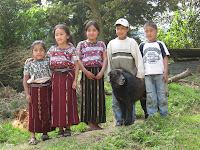


We met a lot of people along the way. Outside the cemetery in Nebaj we applauded as a graduate in cap and gown paraded past flanked by a sobbing mother and a beaming father, and a large extended family bringing up the rear. "Come to our house for tamales!" the father shouted.

Later, sitting inside the town's church Ethan and I accidentally crashed a wedding. No one seemed to mind so we stayed to watch as the bride walked down the aisle dressed in traje and a long white veil. On our way into the church I had noticed an older indigenous woman kneeling and crying in front of an altar just inside the church's entryway. We decided to leave before the "I do's" and so on the way out I stood where the woman had been kneeling. The altar was set back into the wall behind a large blue wooden cross. Behind the iron gate hundreds of small wooden crosses were fixed to the cement and scattered along the floor. Each bore a name and a date. A brightly colored painting hung above the gate depicting the plaza just outside the church's doors, but this scene was different: men, women and children were hog tied, blindfolded and bleeding. The altar was a memorial created to remember the innocent victims of the war. I scanned the crosses to find the most recent year: 1992 - just four years before the peace accords were signed.


Hiking through the foggy wilderness of the Cuchumatanes it was easy to see why the Guerilla Army used the Ixil Triangle as a base of operations; it must have been easy to remain hidden here indefinitely. Every now and then hiking past a fence or beneath a ridge I would look up in time to see a pair of quiet eyes fixed on mine. Sometimes the face would smile, but most often it would disappear quickly out of sight.
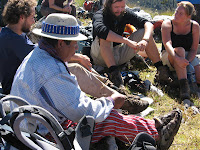

On our last day of trekking we summited La Torre, the highest non-volcanic point in Guatemala, with our host from the night before (pictured above in traditional Todos Santos traje). Sitting under the hot sun, surrounded by stunning views of the volcano chain, he told us his story, the story of his family and of his pueblo during the violence of the 1980s. Under the command of General Efrain Rios Montt, the fighting during the 1980s was particularly brutal and indigenous campesinos were regularly caught in the crossfire between left-wing rebel guerrilla groups and the Guatemalan army. Rios Montt is known for deliberately targeting thousands of indigenous Mayans who were suspected of harboring sympathies for the guerilla movement. Terrorized by regular acts of rape, torture and genocide, many indigenous populations, like the residents of La Ventosa, were persuaded to support the guerillas in exchange for protection from the Guatemalan army.

During one of the guerrilla army's regular visits to the town, many of the villagers of La Ventosa decided to add their names to the list of guerilla sympathizers. However, our host and his father remained ambivalent and ultimately decided not to join. After putting their names to paper, the residents followed the guerilla army's instructions agreeing to down power lines and destroy bridges in order to help disable the army's hold on the region.

Weeks later, our host was awakened before dawn to the sound of screaming. The army had some how gotten hold of the list of guerrilla supporters from La Ventosa and they were rounding up the entire village. Families and neighbors were forced to watch as one by one the guerrilla supporters were tortured and killed. One of the army's victim's that day was our host's uncle who was mistaken for someone else on the list by the same name. Because of an unfortunate scar his uncle had slicing his eyebrow, the army was convinced that he was not only a supporter but also a guerrilla commander. Despite the gruesome torture he was subjected to that day, his uncle miraculously survived, as did the man who shared his name. Our host expressed his grief and his anger at the guerrilla army for letting this happen to the people of La Ventosa. No one on the list had been protected. Later, stuck between the invisible protection promised by the guerrillas, and the terror committed by the army, many residents of La Ventosa agreed to join the army as civilian patrols. Once word spread to the guerrillas, they returned to La Ventosa to set and example. Like the army, they rounded up the civil patrolmen and lynched them in the town's center.

Hearing our host's story was of course heartbreakingly sad, but I was grateful for his candor and willingness to share it. I was grateful too for the way his teenage sons could sit on the mountaintop, aware of the tragic story their father was relating, but mostly enjoying the day and listening to their i-pods.

Later that day we reached Todos Santos where the festival had already begun. We arrived at around 4 PM and men in traditional dress were either already passed out in the street from drinking or weaving around to the tinkle of marimba like zombies. We learned that during the rest of the year the bars are required by law to close early because of the widespread alcoholism in the town.

More than anything else, the festival was strange and sad. Like everyone else I went to watch the 12 hour horse race the next day and stood along the edge in the muck watching the men race back and forth, back and forth. As it turns out they thankfully don't use live chickens anymore to spur on their horses, but many of the riders were swilling beer, or riding hard and fast with their arms held out like airplane wings.


The crowd watched mostly in silence. There was no applause and no cheering. My nerves prickled with the knowledge that at any moment the worst might happen. And then it did. Around the middle of the day one drunken rider left from the wrong end of the track heading toward a line of charging horses at full speed. Two horses crashed with a god-awful sound and flopped upside down onto their backs. The riders lay still and the crowd surged around. Eventually the men stood up and the horses were led spastically out of the track. It's hard to imagine that the horses could have survived the collision. One indigenous woman turned to me and with rare emotion said, "They can kill themselves, but it's horrible - why do they have to kill the horses?"

The race continued for the rest of the day, and after the crash the spectacle seemed a little more subdued and the mood a little lighter. After experiencing the horror of the crash, what was left to fear?

After the trek I have more or less continued at a break-neck pace. I biked to Zunil the day after we got back to Xela, saw the wooden Mayan deity San Simon, and then the next day I climbed volcano Santa Maria just outside Xela with Ethan, Fernando and Jose. The 4,500 foot climb was unrelenting but the views at the top were spectacular. We could see everything: the pacific shore, the volcanoes that jaggedly lead to the lake and Antigua, Tajamulco and, of course, the still active Santiaguito puffing away every forty-five minutes. Far away in the distance we could even see the Cuchumatanes covered in a blanket of cloud.